
Home > Sustainability
Forging Sustainable Value
At Richard Pieris Exports PLC (RPE), sustainability is deeply embedded into our business ethos. The resilience and long-term success of our Group depends on its ability to balance economic growth with environmental responsibility and social equity. In the financial year 2024/25, despite facing macroeconomic volatility, currency fluctuations and pressures from global competition, the Group remained steadfast in its commitment to integrating sustainable practices across all levels of operations. Our approach is aligned with the Global Reporting Initiative (GRI) Standards and we strive to contribute to the United Nations Sustainable Development Goals (UNSDGs), particularly in the areas of responsible consumption and production, decent work and economic growth, and climate action.
Our workforce is the foundation of our business a nd a key enabler of operational excellence. During the year, employee engagement was facilitated through performance appraisals, training sessions, open forums, suggestion schemes and grievance redressal mechanisms. Given the backdrop of industry challenges and currency headwinds, open communication was crucial to maintaining morale and clarity. Key engagement themes included job security, skill development, safety and health, equal opportunity and career advancement. We also conducted health and wellness campaigns and encouraged cross-functional collaboration to foster a strong sense of belonging and team spirit across the Group.
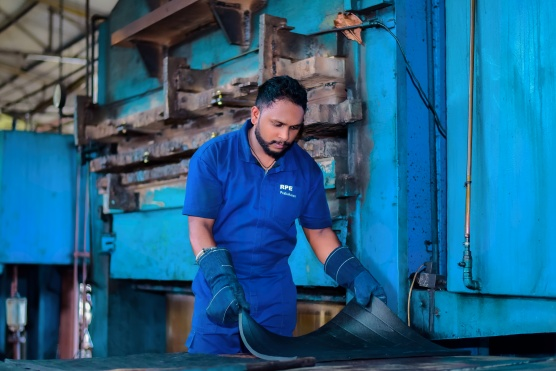
The International Labour Organization (ILO) states that work is a source of personal dignity, family stability, peace in the community and more. The enjoyment of these standards at the highest levels is a basic human right that should be accessible by each and every worker. RPE is committed to protecting the safety, health and welfare of our people engaged in our factories and offices. We have put in place measures and strategies designed to prevent, control, reduce or eliminate occupational hazards and risks.
Apart from preventing, and protecting workers from occupational risks, we feel our responsibility goes further, entailing knowledge of occupational hazards and a commitment to ensure that management processes promote safety and health at work. Training is one of the pivots on which we achieve this, with workers being adequately trained for the work that they are expected to undertake, coupled with knowledge about safety and health aspects of the work, and on ways to prevent or minimize exposure to hazards. We conduct training and information programmes on the prevention and control of hazards, and protection against risks and where necessary, have a structured procedure to deal with accidents and emergencies, including first-aid facilities. The Company Medical Officer visits our factories regularly to provide consultations and treatment.

We view regulatory engagement not only as a compliance requirement but also as a platform for contributing to industry advancement. We maintained regular contact with government agencies such as the Central Bank of Sri Lanka (CBSL), Sri Lanka Export Development Board (EDB), Department of Labour, and environmental authorities. Compliance with all applicable laws, including export regulations, customs documentation, employee welfare standards, and environmental laws, was ensured across the Group. Through our industry associations, including the Sri Lanka Association of Manufacturers and Exporters of Rubber Products (SLAMERP), we advocated for policy support for exporters, infrastructure upgrades, and greater ease of doing business. These engagements helped us stay informed and contribute to the national dialogue on manufacturing and exports.
Our suppliers, including local latex producers and global logistics partners, play a vital role in our value chain. Engagement with suppliers was prioritized to ensure uninterrupted raw material availability, consistent quality, ethical procurement and compliance with environmental and social standards. We maintained continuous dialogue through supplier meetings, joint quality audits and procurement reviews. The year saw heightened collaboration with suppliers on pricing mechanisms due to the volatility in local latex costs, and we worked with selected partners to improve their sustainability practices. Our supplier relationships are governed by long-term commitments that balance commercial needs with mutual growth.

Our suppliers, including local latex producers and global logistics partners, play a vital role in our value chain. Engagement with suppliers was prioritised to ensure uninterrupted raw material availability, consistent quality, ethical procurement and compliance with environmental and social standards. We maintained continuous dialogue through supplier meetings, joint quality audits and procurement reviews. The year saw heightened collaboration with suppliers on pricing mechanisms due to the volatility in local latex costs, and we worked with selected partners to improve their sustainability practices. Our supplier relationships are governed by long-term commitments that balance commercial needs with mutual growth.
Beyond business, we remain firmly committed to uplifting the communities that surround ur operations. In the year under review, our community engagement efforts focused on education, healthcare, and livelihood support. We continued to support school children in low-income households with stationery and scholarships, enabling them to pursue uninterrupted education. Health camps organised in collaboration with local hospitals reached hundreds of community members, providing early diagnosis and referral services for non-communicable diseases. Further, we undertook livelihood development programmes aimed at enhancing income opportunities for rural youth. This included vocational training initiatives in areas such as carpentry, sewing, and rubber tapping. By fostering skills development in our catchment areas, we help reduce unemployment and create a more inclusive local economy. As part of our social contribution for the year, RPNF provided support for flood- affected communities through the donation of mattresses and relief materials, further reaffirming our dedication to national resilience and social solidarity.
Environmental responsibility remains a core part of our operations. During the reporting period, we continued to strengthen initiatives that reduce our environmental footprint while sustaining operational excellence. Efficient use of natural resources—especially water and energy—was a key priority. RPE’s closed-loop water systems helped minimise consumption in washing and latex-processing areas, while the renewable nature of natural rubber used by RPE and Richard Pieris Natural Foams (RPNF) provides a strong sustainability foundation. We further reduced waste through improved recycling of process water, reuse of off-cuts and production rejects, and partnerships with third-party recyclers. Energy management also improved with enhanced monitoring systems and continued reliance on biomass boilers at RPNF, lowering fossil-fuel dependency. Solar installations at selected plants delivered measurable reductions in emissions and operating costs, with expansion plans underway. Additionally, we began aligning our climate-risk assessments with TCFD recommendations to better prepare for supply-chain and climate-related disruptions in the future.

“Richard Pieris Exports PLC’s commitment to the ‘triple bottom line’ concept of People, Planet and Profits takes into consideration the impact of our operations on the economy, society, and environment.”